Showing posts with label EdLab Trends in Ed. Show all posts

Tuesday, October 27, 2009

Trends in Ed, 10. 27. 09

Economy and Internet Trends

Mary Meeker delivered a presentation to Web 2.0 conference recently looking at the state of the economy and the Internet. This presentation quickly looks back over the last few years:
2004 – China Internet – Opportunity is Immense 2005 – Broadband – Becoming Pervasive, Driving Growth in Communications / UGC
2006 – Online Video – Building Momentum
2007 – Social Networks – Proliferating, Driving Platform Changes
2008 – Economic Recession – Creates Challenge + Opportunity for Web Companies
2009 – Mobile Internet – Is and Will be Bigger Than Most Think

It further forecasts the huge growth, and increased integration, of internet-connected devices (see the following slide). The iPhone and social media sites (Facebook, Twitter) figure prominently in her assessment.


The Theory of Connectivism in an Information Age

George Siemens recently presented “Roots of Connectivism” to an open graduate course named Social Media & Open Education, at the Faculty of Education, University of Regina. Based on a basic understanding of various theories of knowledge & learning (e.g., behaviorism, cognitivism, social constructivism, constructionism, neuroscience), the presentation briefly introduces his theory of connectivism. Siemens and Stephen Downes have developed this theory which uses a network as the central metaphor for learning, focusing on knowledge as making connections.


Getting tired of phone calls? – Try Google Voice

Yesterday Google announced that we can now use Google Voice with an existing phone number. Also notably, we can now add Google voicemail service to any of the mobile numbers linked to our account. It is a bit like Gmail for voicemail.




Tuesday, October 20, 2009

Trends in Ed, 10.20.09

ScribbleLive, is a free tool for live blogging with audio and video embeddings. This tool can be accessed via any of your accounts in Facebook, Twitter, Flickr, MSN, etc. The content of live blogging can be further embedded on multiple interfaces such as personal blog site.


Mobile Blogging in WordPress

Writing and viewing blogs have become even more convenient via mobile devices since WordPress just issued two new mobile themes. Check here for more details:

For smartphones with top notch mobile browsers, like the iPhone or Android devices, the theme will be a tweaked version of WPtouch, while other devices will sport a variation of the WordPress Mobile Edition.


Call for Session Proposals - 1st Annual Digital Media and Learning Conference: "DIVERSIFYING PARTICIPATION"

February 18-20, 2010

Submission Deadline: October 30, 2009

Details of the conference can be viewed here.

Henry Jenkins is the Chair of the Digital Media and Learning Conference and our Keynote Speakers will be Sonia Livingstone and S. Craig Watkins.


We encourage sessions that describe, document, and critically analyze different forms of participation and how they relate to various forms of social and cultural capital. We are interested in accounts of the challenges and obstacles which block or inhibit engagement to different forms of online participation. We also encourage session proposals that engage with successful intervention strategies and pedagogical processes enabling once marginalized groups to more fully exploit the opportunities for learning with digital media. Conversely, we are interested in hearing more about how marginal and subcultural communities find diverse uses of new and emerging technologies, pushing them in new directions and navigating a complicated relationship with "mainstream" forms of participation.

Tuesday, October 13, 2009

Trends in Ed, 10.13.09

Solar Powered E-book Developed by LG
After the release of the world's first solar powered cell phone (by Sharp), LG has recently unveiled the world's first solar powered e-book reader.


Parallel Archive - A Place for Digital Scholarship


Parallel Archive is a space where scholars and students in the humanities and social sciences can upload, store, study, and share their digitized archival sources. It is designed to facilitate individual scholarly research and publication; cross-border and cross-disciplinary collaboration; and a critical approach to documents. Compared with Mendeley which helps to store and share academic references, Parallel Archive is not only an academic networking site but also envisioned as an alternative space where scholars can store online and make public their digitized copies of material from archives (at this point similar to PocketKnowledge).

Weebly - The Creation of More Personalized Blog Entries

Weebly has recently become the new favorites of a large number of bloggers. One salient feature of it is that users can freely design their interface during blogging without any technical skills required. It also offers a few interesting user-friendly design functions. The following video will give you more details:

Tuesday, September 29, 2009

The Release of New ELA & Math Standards

The new standards for English language arts (ELA) and mathematics were announced last week:
The Common Core State Standards Initiative is a joint effort by the National Governors Association Center for Best Practices (NGA Center) and the Council of Chief State School Officers (CCSSO) in partnership with Achieve, ACT and the College Board. Governors and state commissioners of education from across the country committed to joining a state-led process to develop a common core of state standards in English-language arts and mathematics for grades K-12.
I had a glance at the ELA standards which are further divided into categories of reading, writing, and speaking & listening. In general, I feel the standards are specific, practical, and well written, from a pedagogical standpoint, trying to promote more scientific/logical thinking and argument skills in language arts. I cited the following standards which seemed interesting and “controversial” to me and began with some questions:

Reading:
Support or challenge assertions about the text by citing evidence in the text explicitly and accurately.
Q: What evidence is determined to be “explicit and accurate”?
Discern the most important ideas, events, or information, and summarize them accurately and concisely.
Q: What content in a fiction book is determined to be the “most important ideas”? Is it test-oriented content? How can the “standard content” be set for every book/reading?

Writing:
Use technology as a tool to produce, edit, and distribute writing.
Q: What types of technology will be included? The traditional WORD or ways of online publishing?

Speaking & Listening
Make strategic use of multimedia elements and visual displays of data to gain audience attention and enhance understanding.
Feedback on the standards is welcome until October 21st.

Tuesday, September 22, 2009

Digital Storytelling Update

Digital Storytelling Webinars

Free Digital Storytelling Webinars will be offered by TechSoup as follows:

Event Schedule:
9/30: Event Day 1 – TechSoup forums event discussions and expert webinars

10/1: Event Day 2 – TechSoup forums event discussions and “How to Create a Digital Story” webinar

10/1: Digital Storytelling Challenge kickoff webinar

10/1-10/16: Digital Storytelling Challenge submission period.

10/19-10/20: Challenge submissions judging

10/21: Winners announced and movie screening party in the virtual world of Second Life and live from San Francisco at the TechSoup headquarters

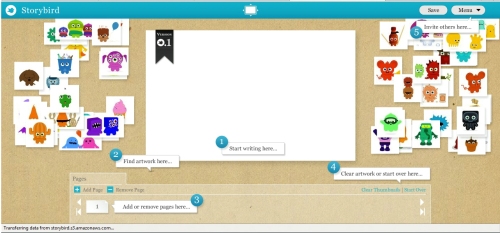
Storybird is “collaborative storytelling for family and friends.” From further investigation, I found some interesting features. In addition to a number of extraordinary online story books, Storybird helps you create a tale with an intuitive book-like interface and a selection of artwork, which are high-quality images from some of the most talented but less well-known children’s illustrators today, like Irisz Agocs and Victoria Usova. The whole story creating process only involves picture selection and text making, which is suitable to younger children to start a trial of digital storytelling.


Based on previous exploration of this topic, I have created the following "glog" to map low-cost tools which can be used in classroom:


Friday, September 11, 2009

Future Publishing: E-Book Builder Trials

I have been trying several e-book building tools at the EdLab this week, including formal online publishing tools and informal personalized tools.


I want to pull them out here to initiate some comparisons.

MagCloud -- The above four-page trial magazine was created via MagCloud, incorporating partial material from the TC Assets Project. It is actually an online magazine converter, via directly uploading your PDF documents to the website. The PDFs must be created according to certain page formats it requires (e.g., templates in Adobe InDesign). It costs nothing to publish a magazine on the website. It only charges for printing and delivery. It is a nice website to publish and promote a magazine. Potential readers/buyers can see a preview of the magazine on the website.

formatpixel -- It is a formal online publishing tool which enables users to design the book online from scratch compared with MagCloud. However, it only offers 512k to free users, so I am not able to further try it out after uploading two pictures.

Sophie -- As said in a previous post, it is a promising tool for publishing multimedia book, with the function of embedding audio and video files. Originally developed by the Institute for the Future of the Book, the development of Sophie has been continued by University of Southern California which owns an avant-garde digital academic journal named VECTORS. Sophie currently is used by Carnegie-Mellon University’s ETC Press and the Computers and Composition Digital Press at Utah State University. Sophie is not easy to use during my trial, because it is a relatively complex and professional tool which needs the devotion of time to get familiar with, like the Adobe design series. It is a free open software and Sophie 2.0 will be issued in mid-October! Currently, I am exploring how it can be embedded online.

SmileBox -- It is a popular tool suitable for informal personalized publishing. Its products include photo albums, crapbooks, calendars, and e-cards, with hundreds of templates. A lot of schools use it with lower graders to design school-life books with simple pictures and texts. This software is also completely free and can be posted online.

ComicLife -- It is also a popular tool, with users such as teachers and students. Compared with SmileBox, it is more like a book builder and it involves more design work without temples provided. Its focus is comic book. See here if interested in knowing more about what a comic book via ComicLife might look like. This tool is not free. It offers a one-month free trial.

Adobe InDesign -- This is probably the most commonly used book design tool known to the publishing field. Its functions are definitely more refined than any of the above tools. MagCloud, formatpixel, and Sophie all have the online publishing function. It seems to me so far that a book/magazine designed via InDesign can only be published via MagCloud.

Wednesday, August 26, 2009

Textbooks Go Digital in California

As reported by eSchool News, California State has approved a new initiative on digital textbooks, which aims at encouraging all public schools in California to use free, open digital textbooks.

The recent state report tells that the main subjects covered in this initiative are math and science (e.g., geometry, biology, chemistry, earth science, etc.) for high school students. The main publishers selected include CK-12 Foundation, Pearson Education, Curriki, Connexions, Dr. H. Jerome Keisler, etc.


The report doesn’t mention how the state will apply those textbooks in public classrooms, in the aspects of available devices, technologies or web resources involved, teaching methods, and curriculum development. In my opinion, this initiative will first of all demand “one desktop/laptop per child” in the classroom, which will definitely cost a lot.

I also wonder how the state will expect teachers to use “static” digital textbooks in various grades. I have a few questions in mind:

  • Can students manage the readings on a computer screen?
  • Is it appropriate to demand teachers use textbooks to teach math and science instead of showing students hands-on examples/experiments in classroom teaching?
  • Will those textbooks be accessible to other states?
  • How can teachers track students’ readings of digital textbooks?
  • How can students make notes of their readings?
  • Will the digital textbooks bring a radical change (see the picture above) to the physical environment of classroom?
  • ...

The books will be issued in the coming months and the state officials are also going to review potential digital textbooks in other subjects (e.g., English literacy?) as reported.


Under the current information age, it is a good strategy for schools to keep updated with technology. However, as for digital textbooks, is the current technology mature enough to bring the engaging literacy experience, activities, and processes of thinking that teachers and educators expect?

Monday, August 24, 2009

New Development of "Green Programs" in the U.S.

As reported by Technical Education, five states -- Georgia, Illinois, New Jersey, Ohio, and Oregon-- have committed to developing green career and technical education initiatives. In collaboration with the United States Department of Education, the states will create secondary and post-secondary programs that will lead to certificates and associate and bachelor degrees.

"Green means healthier learning environments for students and adults, plus lower energy costs and a stronger economy," said U.S. Secretary of Education Arne Duncan, also in a statement released this week. "Green programs of study support the administration's goal of expanding a green workforce by preparing students for high-skill, high-wage jobs in a clean energy economy.
Among the five, Oregon has been pioneering in its industrial construction and development in this field. It has developed a pilot solar-powered high way, the first of its kind in the nation, installed with a 104kW system comprised of 594 panels.
Its annual production is about 128 megawatt-hours – enough to power about 10 typical homes for a year. However, The Oregon Dept of Transportation (ODOT) is using it to power the lights at the I-5 & I-205 exchange.

Meanwhile, earlier this month, Austin announced its pilot program called Sunflowers, An Electric Garden.
Designed by public art team Harries/Heder, the installation consists of 15 flower-like solar photovoltaic panels located on a pedestrian and bike path between the village of Mueller and Austin’s highway I-35.
Global warming and decreased non-renewable energy resources have become the most crucial issues faced by human beings. While, secondary and post-secondary schools have started to pay attention to bring "green" to their program design, mainly focusing on cultivating future "green" engineers/technologists, however, "green" ideas are missed in most of the K-12 curricula. Additional content orientations in arts and aesthetics are mentioned a lot in the educational field, but the idea of applying "green" in daily life are not integrated into K-12 curricula as well as most teacher education programs. While we want our children to be knowledgeable, artistic, creative, critical, and thoughtful as individuals, we also want them to be aware of global and social issues: we really need to work hard to make our living places better, for ourselves and for the next generations.